Tinnitus Worse at Night After 50: Why the Ringing Gets Louder After Dark and How to Sleep With It
 By Emily Carter

The ringing did not get stronger when the sun went down. The world around it got quieter, and that changes everything about how it feels.
Tinnitus usually seems worse at night because the quiet removes the everyday sound that normally covers it, and a tired, stressed brain pays more attention to it. Lying down, a short night, or a long nap can turn it up further. Low-level background sound and therapy for insomnia help most people sleep.
If your tinnitus is worse at night, you are describing one of the most common patterns there is. During the day the ringing sits in the background, behind traffic, conversation, and the television. Then the lights go off, the house goes still, and the sound seems to step forward and fill the room. Many people start to dread bedtime because of it, and that dread is part of the problem.
This guide focuses on the nighttime side of tinnitus. If you want the general picture of what tinnitus is and what causes it, our complete guide to tinnitus causes and what actually helps covers the basics. Here we answer the questions people ask after dark, from why the sound gets louder to how to sleep with it and when to see a doctor.
Why is tinnitus so bad at night?
Mostly because of contrast, not because the ear changes. At night the background sound that masks tinnitus disappears, so the brain's own signal stands out. A large app-based study also found tinnitus was rated louder and more distressing between midnight and 8 a.m., even after accounting for stress.
Tinnitus is generated inside the hearing system, not by a sound in the room. The National Institute on Deafness and Other Communication Disorders (NIDCD) explains that most people with tinnitus have some degree of hearing loss, and that one leading theory involves the brain's sound-processing area, the auditory cortex, changing how it behaves when the ear sends weaker signals.[1] During the day, real sounds compete with that internal signal. At bedtime, the competition is gone.
Silence makes almost anyone hear "phantom" sounds
This is not unique to people with tinnitus. In a 2008 study, 53 young adults with normal hearing sat for four minutes in a soundproof (anechoic) chamber, and 83% reported hearing at least one sound, such as buzzing or ringing, that was not there.[5] The researchers concluded that tinnitus-like perceptions emerge in silence and that suggestion plays only a minor role. A bedroom is not a soundproof chamber, but the principle holds: the less there is to hear, the more the brain notices its own activity.
The time of day itself seems to matter
The most direct evidence comes from the TrackYourTinnitus smartphone app. Researchers analyzed 17,209 momentary ratings from 350 people and found that tinnitus was perceived as louder and more distressing during the night and early morning, from 12 a.m. to 8 a.m., than during the rest of the day.[4] Importantly, the pattern held even after the researchers statistically controlled for how stressed people said they felt. Nighttime tinnitus is a measurable rhythm, not your imagination.
Attention has nowhere else to go
The NIDCD notes that the auditory cortex communicates with parts of the brain that control attention and emotion.[1] At night, there are no emails, errands, or conversations to compete for that attention. If the last thought before sleep is "Is it louder tonight?", the brain treats the sound as something worth monitoring, which makes it harder to tune out. NICE, the UK's National Institute for Health and Care Excellence, lists stress among the things that can make tinnitus worse.[3]
Your hearing aids come out
For anyone who wears hearing aids, bedtime has an extra twist. The NIDCD explains that hearing aids can make tinnitus less noticeable by bringing outside sound back in.[1] The moment you take them out, that extra sound vanishes at once, and the contrast can make the ringing feel louder than it did a minute earlier. If you have never had your hearing checked, our guide to age-related hearing loss explains why gradual high-pitch loss after 45 so often travels with tinnitus.
Why is tinnitus worse when lying down?
Usually for harmless reasons: pressing one ear into a pillow blocks outside sound, and lying still makes body sounds and jaw or neck tension easier to notice. But a whooshing sound in time with your heartbeat that appears or grows when you lie down is pulsatile tinnitus, and it deserves a medical evaluation.
Many explanations stop at "blood flow changes when you lie down." The real picture has a few separate pieces, and it helps to know which one fits you.
The pillow effect
When one ear rests against a pillow, it receives even less outside sound than the room already offers. Many people notice the ringing seems louder in the ear on the pillow side, or that turning over changes it. On its own, this is a masking effect, not a sign of damage. A soft background sound across the room, rather than in one ear, often evens it out.
Neck and jaw position (somatosensory tinnitus)
The NIDCD notes that moving your head, neck, or eyes, or touching certain parts of your body, can produce or change tinnitus symptoms.[1] This is called somatosensory tinnitus. A twisted neck on a high pillow, a clenched jaw, or nighttime teeth grinding are common ways it can show up at bedtime. If your ringing changes when you press on your jaw, clench your teeth, or turn your head, tell your doctor or dentist. It is a useful clue, not an emergency.
Congestion and fluid
A cold, allergies, or an ear infection can make things worse when you lie flat. The NIDCD lists blockage of the ear canal by earwax, or by fluid from an ear infection, as something that can trigger tinnitus.[1] If the ringing arrived with a stuffy head, ear fullness, or ear pain, a primary care visit to check for wax or fluid is a sensible first step.
A heartbeat you can hear
Sometimes lying down simply makes you aware of your own pulse in your ear. If the sound is a rhythmic whoosh that matches your heartbeat, that is pulsatile tinnitus. A 2025 review estimated it accounts for about 4% of tinnitus cases and listed vascular causes, including narrowed carotid arteries, raised pressure around the brain, and blood vessel abnormalities, among the most common.[14] NICE recommends imaging for people with pulsatile tinnitus.[3] Most causes are treatable, but this is not a sound to simply mask and ignore.
Why is tinnitus worse when you're tired or after a bad day?
Because stress and poor sleep feed each other. A tense day leaves the brain on alert, which makes the ringing harder to ignore, and a bad night lowers your tolerance the next day. Research also shows naps can temporarily turn tinnitus up, with snoring and sleep apnea linked to bigger jumps.
The vicious cycle
Tinnitus UK describes a loop that many people recognize: noticing the sound at bedtime triggers worried thoughts, the worry creates anxiety that disrupts sleep, and the poor sleep then raises anxiety further, which keeps the cycle going.[15] The charity also points out that many people with tinnitus sleep well, and that worry about losing sleep may affect sleep quality more than the sound itself.
Sleep problems are common in tinnitus. A 2022 meta-analysis of seven studies covering 3,041 people with tinnitus estimated that about half (53.5%) had impaired sleep.[6] Yet a careful look at older adults offers some reassurance. In the Rotterdam Study, which measured the sleep of 1,456 middle-aged and older adults (average age 65) with wrist-worn activity monitors, people with tinnitus reported taking longer to fall asleep, but their objectively measured sleep was not different from people without tinnitus.[7] The authors concluded that the experience of sleep may be what tinnitus disturbs most. You may be sleeping more than it feels like.

Why a nap can make it louder
A 2024 analysis of two large tinnitus databases found that roughly 3 in 10 respondents said a nap changes their tinnitus (31.1% in one database, 26.9% in the other). Worsening was far more common than improvement: in the larger database, 23.0% said a nap made it a little or a lot worse, while only 8.1% said it made it better.[8] People whose tinnitus reacted to naps were also more likely to say it depended on how well they slept at night, and on stress.
A follow-up sleep-lab study recorded 197 naps in 37 people who reported this problem. Tinnitus measurably increased after naps and eased again between them. The size of the jump was linked to nap length, to snoring, and to the number of sleep apnea events.[9] This is a small study, so it does not prove that snoring causes louder tinnitus. Still, if your tinnitus is often worse when you wake up and you snore, wake unrefreshed, or someone has noticed pauses in your breathing, it is worth asking your doctor about a sleep apnea evaluation.
How do you stop tinnitus from keeping you awake at night?
You usually cannot switch the sound off, but you can stop it from running your night. Avoid total silence with low-level background sound, keep a steady sleep schedule, and treat lingering insomnia with cognitive behavioral therapy for insomnia (CBT-I), which sleep specialists recommend and which has improved sleep in adults with tinnitus.
Most online advice stops at "try white noise and a bedtime routine." Those help, but the American Academy of Sleep Medicine (AASM) suggests that clinicians not rely on sleep hygiene alone to treat chronic insomnia.[11] If tinnitus has cost you sleep for weeks, you need the stronger tools below.
1. Give your brain something gentler to hear
The NIDCD notes that tabletop or smartphone sound generators are typically used as an aid for relaxation or sleep,[1] and the American Academy of Otolaryngology–Head and Neck Surgery Foundation (AAO-HNSF) guideline lists sound therapy as an option for persistent, bothersome tinnitus.[2] A fan, soft rain, a quiet playlist, or a low radio all work. Set the volume a little below your tinnitus, so you can still hear both. The goal is to soften the contrast, not to drown out the ringing.
Honesty matters here: a 2018 Cochrane review found no good evidence that sound devices beat no device for tinnitus severity itself,[12] and NICE was unable to make a recommendation on sound therapy.[3] Think of background sound as a comfort tool for falling asleep, not a cure.
2. Try CBT for insomnia (CBT-I)
CBT-I is a structured program that changes the habits and thoughts that keep insomnia going. The AASM gives multicomponent CBT-I a strong recommendation for chronic insomnia in adults.[11] For tinnitus specifically, a 2021 meta-analysis of randomized trials found that CBT-based programs significantly improved scores on the Insomnia Severity Index, by about 3.3 points on average.[10] The AAO-HNSF also recommends CBT for persistent, bothersome tinnitus,[2] and NICE advises clinicians to ask about sleep and consider screening with the Insomnia Severity Index.[3] Ask your doctor or audiologist about CBT-I, including app-based or online versions.
3. Use your bed only for sleep
Two core CBT-I techniques are worth knowing. Stimulus control means going to bed only when sleepy, and getting up to do something calm in dim light if you cannot sleep, so your brain stops linking the bed with lying awake listening. Sleep restriction means temporarily limiting time in bed to roughly the time you actually sleep, then expanding it as sleep consolidates. The AASM suggests both as single treatments for chronic insomnia.[11] Sleep restriction can make you very tired at first, so it is best done with a clinician's guidance, especially if you drive or have a health condition.
4. Keep naps short and early
Given the nap research above, a long late-afternoon nap is a double hit: it can make the ringing louder on waking and it lowers the sleep pressure you need at night. Protecting your main night of sleep matters more than chasing a perfectly silent bedroom, so if you nap, keep it brief and early.
5. Rethink the coffee rule
"Cut out caffeine" is common tinnitus advice, but the evidence is weaker than most people assume. In the Nurses' Health Study II, which followed 65,085 women for 18 years, higher caffeine intake was linked to a lower risk of developing tinnitus, not a higher one.[13] That study looked at new tinnitus, not nighttime symptoms, and caffeine late in the day can still keep you awake. The practical takeaway: you probably do not need to give up your morning coffee, but avoiding it in the afternoon and evening is sensible for sleep.
6. Wind down your nervous system, not just the room
The AASM suggests relaxation therapy as a single-component treatment for chronic insomnia.[11] Slow breathing, progressive muscle relaxation, gentle stretching, or a short evening walk all count. Some readers ask about viral "tricks" such as tapping the back of the skull. They may feel briefly soothing, but they are not proven treatments, so treat them as relaxation, nothing more.
Nighttime triggers at a glance
| What you notice | Likely reason | What to try first |
|---|---|---|
| Louder as soon as the room goes quiet | Loss of background masking | Low-level background sound across the room, set just below the ringing |
| Jumps when you take hearing aids out | Sudden drop in outside sound | Start background sound before removing them; ask your audiologist about tinnitus features |
| Louder in the ear on the pillow | That ear is partly blocked from room sound | Sound source placed across the room; try the other side or a lower pillow |
| Changes when you clench, turn your neck, or press your jaw | Somatosensory tinnitus | Mention it to your doctor or dentist, especially if you grind your teeth |
| Worse after a nap or on waking, and you snore | Nap-related modulation; possible sleep apnea | Short, early naps; ask about a sleep apnea evaluation |
| Worst after a stressful day or a short night | Stress and sleep loss raise attention to the sound | Wind-down routine; CBT-I if insomnia lasts for weeks |
| A whooshing beat that matches your pulse | Pulsatile tinnitus | Book a medical appointment; imaging is usually recommended |
What should you do when tinnitus wakes you up at 3 a.m.?
Don't lie there listening. Everyone wakes briefly during the night; tinnitus mostly makes you notice it. Turn on low-level sound, and if sleep doesn't return after a while, get up and do something calm in dim light until you feel sleepy. Avoid checking the clock or your phone, which keeps the brain alert.
Tinnitus UK makes a point that changes how many people see these wake-ups: we normally do not remember natural awakenings during the night, but if you wake enough to notice your tinnitus, you may stay awake longer and remember it the next day.[15] The awakening is normal. The listening that follows is what stretches it out.
A simple middle-of-the-night plan
- Have sound ready. Keep your fan, radio, or sound app set up before bed so you do not have to fumble for it.
- Do not test the ringing. Covering your ears or holding your breath to "check" it teaches the brain it matters.
- Leave the clock alone. Calculating how many hours are left raises stress, which the NICE guideline lists among things that can make tinnitus worse.[3]
- Get up if sleep doesn't return. This is the stimulus control step the AASM suggests for chronic insomnia.[11] Sit somewhere comfortable, read something gentle on paper, and return to bed when sleepy.
- Write the worry down. A notebook by the chair lets you park tomorrow's concerns instead of rehearsing them.
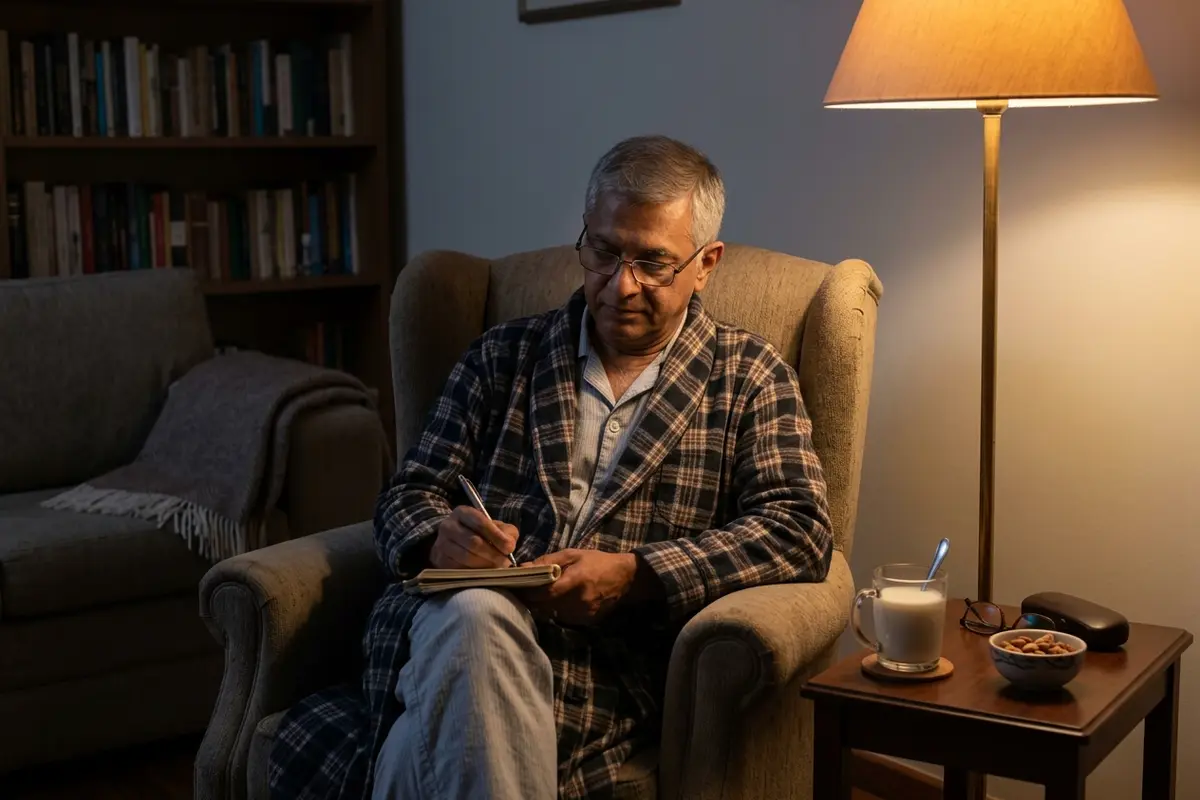
Illustrative scenario (a composite, not a real person): Picture a 58-year-old bookkeeper who wakes most nights around 3 a.m., hears the ringing, and lies awake until dawn. Her primary care doctor finds no warning signs and refers her for a hearing test and an online CBT-I course. She starts a fan at bedtime, stops napping after lunch, and gets up to read when she cannot sleep. Months later the ringing is still there at 3 a.m., but she drifts back to sleep instead of fighting it.
What about melatonin, sleeping pills, and medicines?
The AAO-HNSF guideline recommends against melatonin, ginkgo biloba, zinc, or other dietary supplements for treating persistent, bothersome tinnitus, and against routinely using antidepressants, anticonvulsants, or anti-anxiety drugs to treat tinnitus itself.[2] That is about treating the ringing, though. The NIDCD notes that a doctor may prescribe medicine to improve mood or help you sleep.[1] Discuss any sleep aid with your doctor, and if your tinnitus started or worsened after a new prescription, mention it rather than stopping the medicine on your own. Our review of vitamins and nutrients for ear health covers when a nutrient deficiency is worth testing for.
Protect your ears during the day, too
NICE lists exposure to loud noise among the things that can make tinnitus worse.[3] A loud restaurant, power tools, or earbuds at high volume during the day can leave the ringing louder by evening. Our guide to everyday habits that quietly damage hearing lists the common culprits, and our article on noise-induced hearing loss explains how to protect what you have.
Is tinnitus at night harder to live with after 50?
Often, yes. After 50, sleep naturally becomes lighter, with more brief awakenings, so there are more quiet moments to notice the ringing. Hearing loss also becomes more common with age, and taking hearing aids out at bedtime makes the room even quieter. Planning for both makes the nights easier.
The National Institute on Aging explains that older adults need about the same seven to nine hours of sleep as younger adults, but their sleep tends to be shorter and lighter, and they may wake up more often during the night.[18] Each of those awakenings is a quiet moment in which tinnitus can grab your attention. At the same time, about one in three people between 65 and 74 has hearing loss, and nearly half of those older than 75 have difficulty hearing.[19] Hearing loss and tinnitus often travel together, and with less outside sound reaching the brain at night, the ringing can stand out more.
Three adjustments that matter more at this age
- Plan for the moment your hearing aids come out. If you wear hearing aids, the room goes very quiet when you take them out for the night. Start your fan or sound machine before you remove them, so your brain never meets total silence. Ask your audiologist whether your aids have a built-in tinnitus sound program you can use in the evening.
- Be careful with over-the-counter sleep aids. Many "PM" products contain diphenhydramine or doxylamine. The American Geriatrics Society Beers Criteria advise adults 65 and older to avoid these older antihistamines, because they are strongly anticholinergic and are linked to a higher risk of confusion and falls.[20] Ask your doctor or pharmacist before trying any sleep aid.
- Make night-time wake-ups safe. If you get up when the ringing keeps you awake, the National Institute on Aging suggests a lamp that is easy to reach, a nightlight in the hallway or bathroom, and clearing away rugs and cords you could trip over.[18]
Building a calmer evening routine for your ears?
Alongside a wind-down routine and a hearing check, some readers like to add a daily supplement for ear health. Audifort is a liquid drop formula that the manufacturer says combines plant extracts and nutrients to support the inner ear. We looked closely at its label, its price per bottle, and its 90-day money-back guarantee. Research on ear supplements is still limited, so our review sticks to what is actually known and what is still open. A supplement can be one small part of your routine, never a substitute for care.
See how Audifort scored in our review → Our review page contains affiliate links. If you buy through them, Better Hearing Daily may earn a small commission at no extra cost to you. This does not change our editorial view.When should you see a doctor about tinnitus that's worse at night?
See a doctor if nighttime tinnitus is new, in one ear only, pulses with your heartbeat, or comes with hearing loss, dizziness, or headaches. Sudden hearing loss is an emergency. Also book a visit if it disrupts sleep for weeks or you snore and wake unrefreshed. If you feel hopeless or unsafe, call or text 988.
Do not wait until morning; call 911 or go to the emergency room or same-day care if tinnitus arrives with:
- Sudden hearing loss in one or both ears. The NIDCD says to consider sudden deafness a medical emergency and see a doctor immediately,[16] and NICE advises being seen within 24 hours when hearing loss developed over 3 days or less in the past 30 days.[3]
- Sudden neurological symptoms, such as facial weakness, or severe uncontrolled vertigo, which NICE says need immediate referral.[3]
- Thoughts of suicide or self-harm. You can reach the 988 Suicide & Crisis Lifeline any hour of the night by calling or texting 988, or by chatting at 988lifeline.org; it is free and confidential.[17] Long sleepless nights can wear anyone down, and asking for help is the right call.
Book a prompt appointment if:
- The sound pulses in time with your heartbeat, especially if it appears or grows when you lie down. NICE recommends imaging for pulsatile tinnitus.[3]
- It is in one ear only. The AAO-HNSF recommends a prompt, comprehensive hearing evaluation for one-sided or persistent tinnitus.[2]
- It comes with dizziness or spinning spells, which can point to inner-ear conditions such as Ménière's disease.[1]
- You snore loudly, wake gasping, or feel unrefreshed, and your tinnitus is worst on waking. A sleep apnea evaluation may be worthwhile.
- Poor sleep has lasted for several weeks. Ask specifically about CBT-I and about tinnitus-focused CBT.
Not sure whether your hearing has changed? Our checklist of early warning signs of hearing loss can help you prepare for the appointment, and our main tinnitus guide on causes and when to get checked lists what your doctor is likely to look for. Tinnitus that is worse at night can make bedtime feel like a battle. The evidence points to a calmer approach: soften the silence, protect your main night of sleep, treat insomnia properly, and let a clinician rule out the few causes that need it.
Frequently asked questions
Is it normal for tinnitus to be worse at night?
Why is my tinnitus louder when I wake up in the morning?
Can lack of sleep make tinnitus worse?
Should I sleep with earplugs if I have tinnitus?
Does melatonin help tinnitus at night?
Is tinnitus that gets worse after a nap a bad sign?
Sources
- National Institute on Deafness and Other Communication Disorders — Tinnitus.
- Tunkel, D.E., et al. "Clinical practice guideline: tinnitus." Otolaryngology–Head and Neck Surgery, 2014;151(2 Suppl):S1–S40. PubMed.
- National Institute for Health and Care Excellence — Tinnitus: assessment and management (NG155), 2020.
- Probst, T., et al. "Does tinnitus depend on time-of-day? An ecological momentary assessment study with the 'TrackYourTinnitus' application." Frontiers in Aging Neuroscience, 2017;9:253. PubMed; full text (PMC).
- Del Bo, L., et al. "Tinnitus aurium in persons with normal hearing: 55 years later." Otolaryngology–Head and Neck Surgery, 2008;139(3):391–394. PubMed.
- Gu, H., Kong, W., Yin, H., Zheng, Y. "Prevalence of sleep impairment in patients with tinnitus: a systematic review and single-arm meta-analysis." European Archives of Oto-Rhino-Laryngology, 2022;279(5):2211–2221. PubMed.
- de Feijter, M., Oosterloo, B.C., Goedegebure, A., Luik, A.I. "The cross-sectional association between tinnitus and actigraphy-estimated sleep in a population-based cohort of middle-aged and elderly persons." Ear and Hearing, 2023;44(4):732–739. PubMed; full text (PMC).
- Guillard, R., et al. "Results of two cross-sectional database analyses regarding nap-induced modulations of tinnitus." Scientific Reports, 2024;14(1):20111. PubMed; full text (PMC).
- Guillard, R., et al. "Why does tinnitus vary with naps? A polysomnographic prospective study exploring the somatosensory hypothesis." Hearing Research, 2025;455:109152. PubMed.
- Curtis, F., et al. "Effects of cognitive behavioural therapy on insomnia in adults with tinnitus: systematic review and meta-analysis of randomised controlled trials." Sleep Medicine Reviews, 2021;56:101405. PubMed.
- Edinger, J.D., et al. "Behavioral and psychological treatments for chronic insomnia disorder in adults: an American Academy of Sleep Medicine clinical practice guideline." Journal of Clinical Sleep Medicine, 2021;17(2):255–262. PubMed; full text (PMC).
- Sereda, M., Xia, J., El Refaie, A., Hall, D.A., Hoare, D.J. "Sound therapy (using amplification devices and/or sound generators) for tinnitus." Cochrane Database of Systematic Reviews, 2018;12:CD013094. PubMed; full text (PMC).
- Glicksman, J.T., Curhan, S.G., Curhan, G.C. "A prospective study of caffeine intake and risk of incident tinnitus." The American Journal of Medicine, 2014;127(8):739–743. PubMed.
- Alvear, A.S., et al. "Pulsatile tinnitus: a narrative review." The Journal of International Advanced Otology, 2025;21(4):1–7. PubMed.
- Tinnitus UK — Tinnitus and sleep.
- NIDCD — Sudden Deafness.
- 988 Suicide & Crisis Lifeline — 988lifeline.org.
- National Institute on Aging — Sleep and Older Adults.
- NIDCD — Age-Related Hearing Loss (Presbycusis).
- 2023 American Geriatrics Society Beers Criteria Update Expert Panel. "American Geriatrics Society 2023 updated AGS Beers Criteria for potentially inappropriate medication use in older adults." Journal of the American Geriatrics Society, 2023;71(7):2052–2081. PubMed.