What to Expect at Your First Hearing Test
 By Emily Carter

A first hearing test is one of the shortest, most painless health appointments most adults will ever have — and one of the most useful.
Your first hearing test is a calm, painless appointment that usually takes up to about an hour. An audiologist reviews your history, looks inside your ears, and plays soft tones through headphones while you press a button when you hear them. You leave with an audiogram — a simple chart of your hearing — and a plain-English explanation of what it means.
If you have been putting off booking a first hearing test, you are in good company. Delay is the norm with hearing: in a long-running U.S. study of adults followed for years (Simpson et al., Ear and Hearing, 2019), people waited an average of 8.9 years between the point their hearing qualified them for hearing aids and actually getting them. Part of that wait is simple worry — about aging, about what the test involves, about what the answer might be.
Here is the short version: a modern hearing evaluation is one of the least stressful medical appointments you can book. Nothing goes into your ear that would hurt. There is no needle, no radiation, no fasting, no recovery time. The room is unusually quiet, but that is the strangest thing that happens to you. This guide walks you through exactly what to expect — the phone call to book it, the intake questions, each step in the sound booth, the audiogram at the end, what it costs, and what happens next if the test finds something.
What actually is a hearing test?
A hearing test is a short set of painless measurements that maps how well each ear hears across different pitches and volumes. The core is pure-tone testing in a quiet booth, usually alongside a look inside the ear, a pressure test of the eardrum, and speech tests. Together they show whether you have hearing loss and which kind.
A hearing test — clinically called a hearing evaluation or audiologic assessment — is a set of quick, painless measurements a trained specialist performs to map how well each ear picks up sound across a range of pitches and volumes. It is not a single question ("can you hear me?"); it is a small battery of tests, and each one answers something different.
The core of the appointment is pure-tone audiometry, in which you sit in a sound-treated booth and raise your hand or press a button every time you hear a beep. The audiologist then plots your responses on a chart called an audiogram. Around that core, a full evaluation usually includes a case-history conversation, a look inside the ear with an otoscope, speech tests, and often a simple pressure test (tympanometry) that checks how your eardrum is moving. Pure-tone, bone-conduction, speech, and tympanometry testing are the standard pieces MedlinePlus describes for audiometry. Together, these paint a full picture: not just whether you have hearing loss, but which kind and where in the ear it is happening.
That distinction matters. Hearing changes can come from very different places — the outer ear (wax, a blocked canal), the middle ear (fluid, an infection, a stiff bone), or the inner ear and nerve (aging, noise damage, medication side effects). The test tells the specialist which corner to focus on, and it is why one visit gives you far more useful information than any at-home phone app can.
Where should you go for your first hearing test?
For gradual changes, most adults start with an audiologist, the professional trained to test hearing and fit hearing aids. Sudden hearing loss, ear pain, drainage, dizziness, or one-sided symptoms call for an ear, nose, and throat doctor first. Free screenings and phone apps can flag a problem, but they cannot replace a full evaluation.
Where you go depends mainly on the symptoms you are bringing in (and, if you use Medicare or insurance, on whether your plan wants a doctor's order first — more on that below). The three usual options each have a place.
Audiologist (the usual first stop)
An audiologist is the licensed hearing-care professional trained specifically to test hearing and fit hearing aids. If you are noticing gradual changes — turning the television up, missing words in restaurants, asking people to repeat themselves — this is who you want. Independent audiology clinics, hospital ENT departments, and university hearing centers commonly offer diagnostic evaluations; ask about the price and what is included when you book.
Ear, nose, and throat physician (ENT / otolaryngologist)
An ENT is a medical doctor who can diagnose and treat medical problems of the ear. Start there — not with an audiologist — if you have any of these symptoms: sudden hearing loss in one or both ears, ear pain, drainage from an ear, persistent dizziness, or hearing that is significantly worse on one side than the other. In these cases the ENT will usually order a hearing test themselves, sometimes on the same day, using an audiologist working within the practice.
Free community and retail screenings
Some hearing-aid retailers, senior centers, and health fairs advertise free hearing screenings. These are useful for a rough yes-or-no answer to "should I get this looked at more carefully?" They are not diagnostic — they use a limited range of frequencies and often no sound booth — so a "pass" does not rule out a real problem, and a "fail" always needs a follow-up appointment for a proper evaluation. Think of a free screening as a doorbell, not a diagnosis.
A note on online and app-based hearing tests: several are well designed, but even the best ones cannot control for background noise, headphone quality, or ear-canal issues. Use them for curiosity or to nudge you toward booking a real appointment — not as a substitute for one.
What happens during a hearing test, step by step?
Usually six steps. You talk through your health history, the audiologist looks inside your ears, a quick pressure test checks your eardrum, and then you press a button for faint tones in a sound booth. Speech tests come next, and the visit ends with a plain-language walk-through of your results.
The single biggest thing that shrinks anxiety about a first hearing test is knowing the order of what happens. Here is how a standard adult evaluation flows.
1. Intake and case history
You will sit in a normal consultation room while the audiologist asks about your general health, medications, noise exposure at work or in hobbies, family history of hearing loss, and the specific symptoms that brought you in. Bring a list of your medications if you can — the American Speech-Language-Hearing Association notes that some medicines, including certain antibiotics, some chemotherapy drugs, and high doses of aspirin, can affect hearing, and that context matters.
2. Otoscopy — a quick look inside the ear
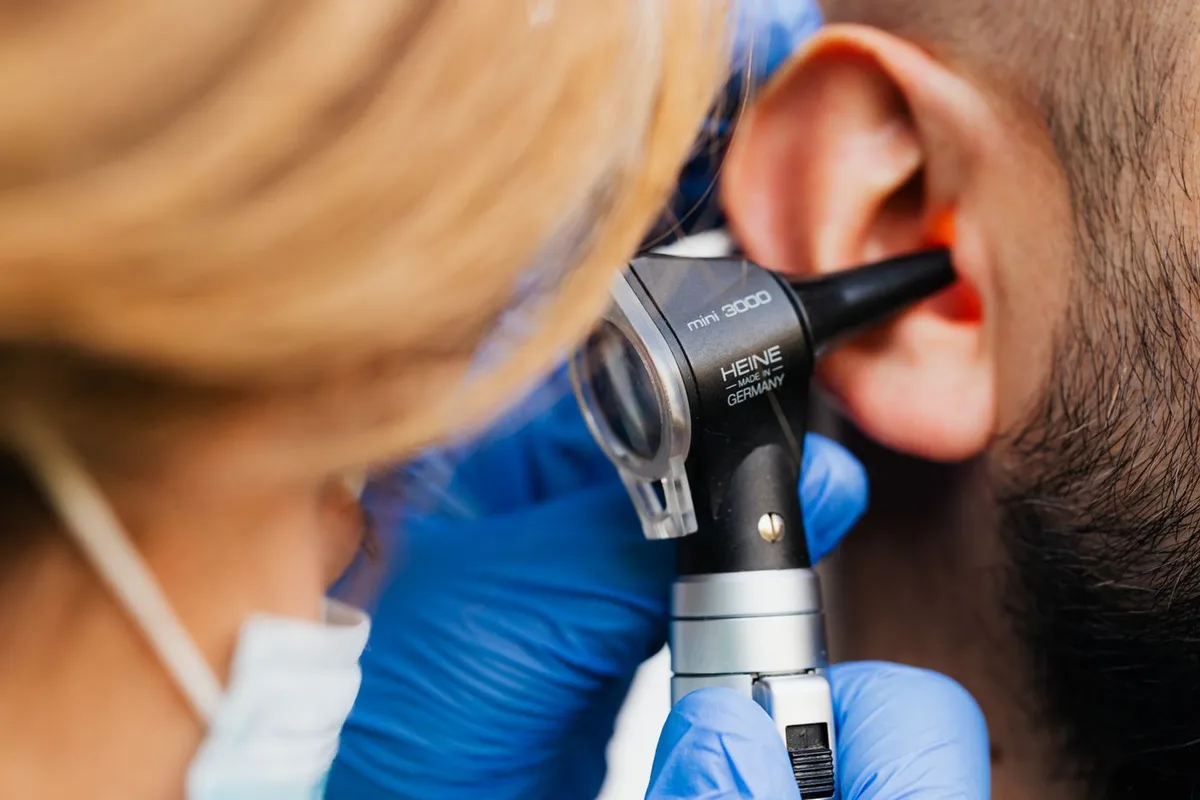
Next, the audiologist uses a small handheld light called an otoscope to look down each ear canal at the eardrum. It does not hurt and it takes seconds per ear. This is where wax buildup, redness, or a perforated eardrum would be spotted — any of which can affect the numbers on the test and change what happens next.
3. Tympanometry — the pressure test
The audiologist places a soft rubber tip in each ear and briefly changes the air pressure in the canal to measure how easily your eardrum moves. It feels like a very small pop — similar to swallowing on a plane — and takes only a few seconds per ear. This test flags middle-ear problems (fluid, a stuck eardrum, an infection) that a pure-tone test alone would miss.
4. Pure-tone audiometry — the core of the test
Now you move into the sound-treated booth. It is a small, comfortable room with padded walls that block outside sound. You sit down, put on headphones or foam-tipped inserts, and hold a response button. The audiologist, who sits at a console on the other side of a window, plays tones at different pitches and volumes. You press the button — or raise a finger — every single time you hear one, even if it is very faint.
Two things about this stage surprise almost every first-timer. The first: some tones feel absurdly quiet, and you will wonder whether you are imagining them. Press the button anyway. The point of the test is to find your threshold, the softest sound you can consistently detect, so guessing on the edge of hearing is not cheating — it is exactly what the test is measuring. The second: the booth is quieter than most rooms you will ever sit in, and that quietness can feel a little strange for the first minute. It settles quickly.
Depending on the clinic, this stage may also include bone-conduction testing, where a small vibrating headband is placed just behind the ear. It sends sound directly to the inner ear, bypassing the outer and middle ear. Comparing air-conduction and bone-conduction results is how the audiologist figures out where in the ear the loss is happening.
5. Speech testing
Most evaluations finish with two speech tasks. In the first, you repeat two-syllable words at decreasing volume to find the softest level at which you can reliably understand speech. In the second, you repeat single words at a comfortable listening volume — this measures how clearly you understand speech even when it is loud enough. That second score helps the audiologist judge how much hearing aids or other devices are likely to help.
6. Results and next steps
Back in the consultation room, the audiologist pulls up your audiogram and walks you through it in plain language. This is your appointment — take up the time. Ask about specific frequencies, ask whether the pattern matches noise damage, aging, or something else, and ask what they would recommend if you were their family member. A good audiologist welcomes those questions.
How long does a hearing test take, and does it hurt?
It does not hurt. A quick screening can take 5 to 10 minutes, and a detailed evaluation takes up to about an hour, according to MedlinePlus. Nothing sharp enters the ear: soft tips, headphones, and a gentle pressure change are the most you will feel. The booth's unusual quiet is what surprises most people.
According to MedlinePlus (U.S. National Library of Medicine), a basic hearing screening can take as little as 5 to 10 minutes, while detailed testing takes about an hour. For a first diagnostic visit, plan on the longer end and leave some buffer: the conversation before and after the booth is part of the appointment. If you are also being fitted for hearing aids on the same day, ask the clinic how much extra time to allow.
Pain-wise, there is nothing to worry about — MedlinePlus states plainly that there is no discomfort. Nothing sharp enters the ear. The foam or rubber tips are the same kind used in earbuds. The tympanometry pop is milder than clearing your ears on takeoff. The bone-conduction headband presses gently behind the ear and can feel a bit unusual for the first few seconds, but never hurts. The single sensation that catches some first-timers off guard is the silence of the booth — noticeably quieter than any everyday environment — and that is a feature, not a flaw.
What is an audiogram and how do you read one?
An audiogram is the chart of your results. Pitch runs from low on the left to high on the right, and loudness from soft at the top to loud at the bottom, so higher marks mean better hearing. O usually marks the right ear and X the left. Thresholds of 25 dB HL or better are generally normal for adults.
The audiogram is the single most useful thing you take home from a first hearing test. It looks like a small graph — horizontal axis, vertical axis, a few marks on each side — but once you can read it, you have a real picture of what your ears are doing.
The horizontal axis is pitch (frequency, measured in hertz), running from low pitches on the left to high pitches on the right. A standard adult test usually checks tones from about 250 Hz to 8,000 Hz, the range MedlinePlus uses to describe normal results.
The vertical axis is loudness, measured in decibels of hearing level (dB HL), running from 0 at the top (very quiet) down to about 110 or 120 at the bottom (very loud). Counter-intuitively, the top of the chart represents the softest sounds, and the bottom represents the loudest. The higher your marks sit on the page, the better your hearing is at that pitch.
Marks are usually recorded with an O for the right ear and an X for the left, connected by a line to show the pattern across pitches. Here is how the American Speech-Language-Hearing Association labels each range (the descriptions after each label are a plain-English summary). MedlinePlus describes hearing tones at 25 dB or lower as a normal result:
- –10 to 15 dB HL — normal hearing.
- 16 to 25 dB HL — slight loss on ASHA's scale, though still within the 25 dB range MedlinePlus calls normal.
- 26 to 40 dB HL — mild hearing loss. Soft speech and consonants become hard to catch, especially in noise.
- 41 to 55 dB HL — moderate loss. Normal conversation is difficult without help.
- 56 to 70 dB HL — moderately severe. Even loud speech is challenging.
- 71 to 90 dB HL — severe loss. Only very loud sounds are heard without assistance.
- 91+ dB HL — profound loss.
Two patterns are especially common at a first test. A gently sloping line that is normal on the left of the chart and drops down on the right is typical of age-related hearing loss, which usually affects high frequencies first. A sharper notch in the 3,000 to 6,000 Hz range — often deepest near 4,000 Hz, with partial recovery at 8,000 — is the classic pattern of noise-induced hearing loss, as described in the clinical reference StatPearls: Audiogram Interpretation, although it is not present in everyone. Your audiologist will interpret the pattern for you, but knowing what you are looking at makes the conversation much richer.
Does insurance or Medicare cover a hearing test?
Often, yes. Original Medicare Part B covers diagnostic hearing exams ordered by your doctor, and you can see an audiologist once a year without an order for gradual hearing loss. It does not cover hearing aids or fitting exams. Private insurance and Medicare Advantage benefits vary, so call your plan before booking.
Prices for a cash-pay evaluation vary a lot by clinic and region, so ask for the price and what it includes when you book. Coverage is easier to pin down:
- Original Medicare (Part B): according to Medicare.gov, Part B covers diagnostic hearing and balance exams when your doctor or another provider orders them to find out whether you need medical treatment. You can also see an audiologist once every 12 months without an order for non-acute hearing problems, such as hearing loss that develops over many years. After the Part B deductible, you generally pay 20% of the Medicare-approved amount.
- What Original Medicare does not cover: hearing aids and exams for fitting hearing aids.
- Medicare Advantage (Part C): some plans offer extra hearing benefits that Original Medicare does not. Check your specific plan.
- Private insurance: highly variable. Some plans want a referral first, and coverage of hearing aids themselves is a separate matter. Call the number on the back of your card and ask about your specific plan.
- Free screenings and hearing-aid sellers: some retailers and community events offer free screenings or tests. They can be a useful first step, but a screening is not a full diagnostic evaluation, and a seller's visit will usually include product recommendations.
If cost is the barrier, do not skip the appointment altogether. Ask your primary care doctor about an order for a diagnostic test, check what your plan covers, or start with a free screening — and if it flags something, follow up with a full evaluation.
What happens after the test if it finds hearing loss?
It depends on the type and degree of loss. Mild loss often means listening strategies, retesting later, or over-the-counter hearing aids, while moderate loss usually calls for prescription hearing aids fitted by an audiologist. Sudden or one-sided loss needs a prompt referral to an ENT, because the NIDCD treats sudden deafness as a medical emergency.
Many people arrive at a first hearing test already suspecting something is up, often after noticing changes for years. So a result that confirms mild or moderate loss is rarely a surprise. What often is a surprise is how much room there is between "the test found something" and "you need hearing aids tomorrow."
Mild high-frequency loss
This is a common finding at a first adult hearing test, and usually the least dramatic path forward. Depending on your day-to-day struggle, options often include a watch-and-recheck plan (retesting on the schedule your audiologist suggests), simple listening strategies (better restaurant seating, captions, facing the speaker), and — if the frustration is real — over-the-counter hearing aids, a category the FDA created for adults 18 and older with perceived mild to moderate hearing loss, in effect since October 2022.
Moderate loss with speech-in-noise trouble
If your speech-in-noise score is meaningfully worse than your quiet-room score, your audiologist will likely talk to you about prescription hearing aids fitted to your audiogram. Many modern devices are small and rechargeable, and it is worth asking whether the clinic offers a trial period so you can test them in your real life before committing.
Sudden or one-sided loss
If the test confirms a sudden or significantly asymmetric loss, expect a prompt referral to an ENT. The NIDCD says sudden deafness should be treated as a medical emergency: steroids work best when started as soon as possible, and treatment delayed more than two to four weeks is less likely to help. One-sided loss always warrants further medical evaluation.
Persistent ringing or tinnitus alongside the loss
Ringing in the ears is common in people with noise-related or age-related hearing loss. The NIDCD calls hearing aids one of the main treatment options for people who have tinnitus along with hearing loss, because amplifying outside sounds can make the ringing less noticeable. Our companion article on tinnitus causes and what actually helps covers the strategies with the best evidence behind them.
Whatever the finding, remember that a hearing test is a starting line, not a finish line. It gives you and the audiologist a shared baseline. You can retest in a year, compare, and see whether the change is standing still or moving — which is far more valuable information than any single result.
How should you prepare for a hearing test?
Very little preparation is needed. Bring a list of your medications and supplements, avoid loud noise the day before so a temporary dip does not skew results, skip the cotton swabs, and write down the situations where you struggle most. Bringing a family member and asking for a copy of your audiogram also helps.
You do not need to do much, but a few small things make the visit more useful.
- Bring a list of your medications, including supplements. A handful of drug classes are known to affect hearing, and that context helps the audiologist read the results.
- Bring a family member if you can. A second set of ears in the results conversation catches details you might miss, and their outside perspective on your daily struggle is genuinely useful data.
- Avoid very loud environments the day before the test. Concerts, motorcycle rides, and long headphone sessions can cause a temporary dip in hearing that skews the numbers. Workplace hearing programs take this seriously: OSHA's noise standard requires at least 14 hours without workplace noise before a baseline hearing test.
- Do not clean your ears with cotton swabs beforehand. The audiologist wants to see what is really there, wax and all. If there is a significant blockage, they will address it and, if needed, reschedule the tone test.
- Write down your two or three biggest listening frustrations in advance: the restaurant, the grandkids on the phone, one specific TV show. The audiologist can tailor the test and the recommendations to those situations.
- Ask for a copy of the audiogram. Under HIPAA, you generally have the right to see and get copies of your health records, and having your own copy makes any future test — with the same clinic or a new one — infinitely more informative.
And — this is the part almost nobody tells you — book the appointment for a morning when you are not rushed. Give yourself an hour of buffer afterward. The results conversation is short, but the emotional processing can take a little longer, especially if this is the visit where a suspicion becomes a fact. Coffee with someone who knows you, right after, is often the quiet part that matters most.
Audifort: a question some readers ask after the test
When the audiogram is back, some people wonder what else they can do day to day. Audifort is a liquid supplement that its maker says blends plant extracts and B-complex nutrients to support inner-ear health. It cannot test, diagnose, or treat hearing loss, and it will not restore damaged hair cells. Talk to your audiologist before adding it. Results vary from person to person, and the maker backs it with a 90-day money-back guarantee.
Read our full Audifort review → Our review page contains affiliate links. If you buy through them, Better Hearing Daily may earn a small commission at no extra cost to you. This does not change our editorial view.Frequently asked questions
Does a hearing test hurt?
How long does a first hearing test take?
Does Medicare cover a hearing test?
Should I see an audiologist or an ENT doctor for my first hearing test?
What is an audiogram and how do I read it?
The appointment matters more than anything on this page
If you have been putting off a hearing test, book it this week. It is quick, painless, and gives you a baseline to compare against for years. Should you later want to look at a supplement alongside your specialist's advice, our Audifort review covers the label and the fine print. It is not a treatment for hearing loss.
Read our full Audifort review → Our review page contains affiliate links. If you buy through them, Better Hearing Daily may earn a small commission at no extra cost to you. This does not change our editorial view.